A mouse lived longer. What does that tell us about human longevity?
A reproducible animal result can justify further research. It cannot by itself establish additional human years, a useful dose or the balance of benefit and harm in people.
Verdict: a mouse lifespan result supports a claim about the mice studied. A claim of longer human life needs additional evidence in people. The gap is not resolved by converting mouse months into human years or by noting that the same compound is available to buy.
Animal research can answer important questions about aging. The reading task is to preserve what the experiment established while keeping the proposed human benefit separate.
Start with the experiment, not the headline
In its July 2026 explanation of the Interventions Testing Program, The Jackson Laboratory describes coordinated testing at three sites using genetically diverse mice. Researchers follow treated and comparison animals across their lives. These design features help address consistency and reproducibility in animal research.
They do not turn those animals into human trial participants. When taking notes on a claim, record the species, sex, genetic background, starting age, intervention, comparison and outcome. If the material you read does not supply a detail, mark it not available in this source.
Keep the finding and the proposed benefit separate
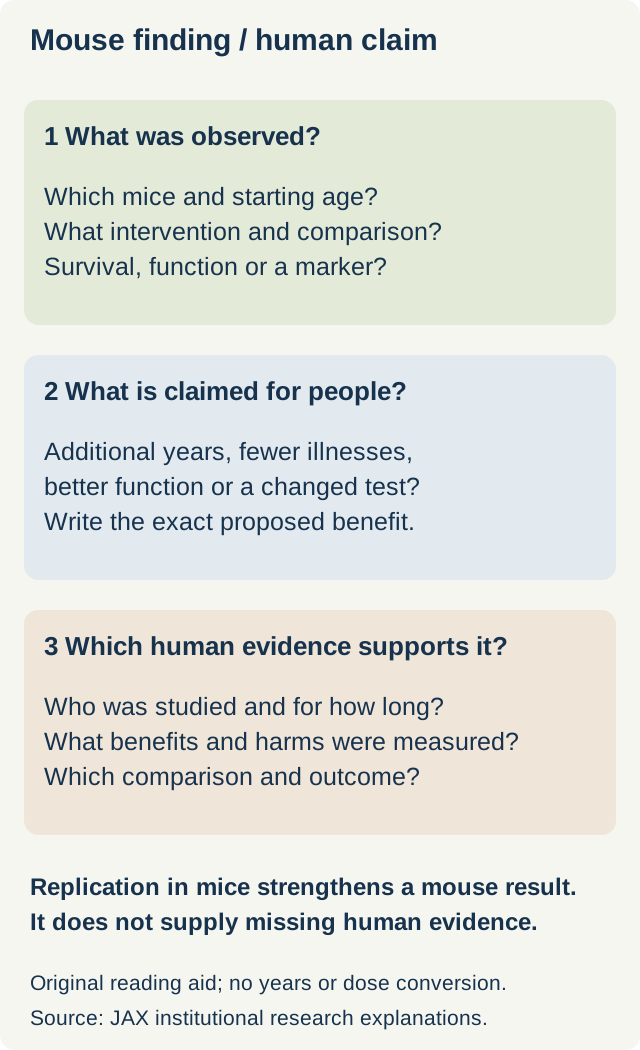
Figure: the evidence boundary between a mouse finding and a human promise. This is an original reading map based on JAX's explanation of its research. It is not a validated score, a drug-development pathway or an estimate of human benefit. The boxes identify different questions; they are not a guarantee that a finding will eventually translate.
Ask whether the animal experiment measured survival, a laboratory marker, physical function or another outcome. Keep the measured outcome in the sentence describing the result. An appealing account of a biological mechanism does not fill an unmeasured human outcome field.
For a human claim, ask which study in people supports it: who participated, what was compared, what outcomes and harms were measured, and for how long. The question is about the particular claim and evidence. It does not require dismissing all animal work or assuming that every promising result will become a treatment.
An example with a limited source
JAX's October 2024 account of a diet experiment describes female mice assigned to different feeding regimens and followed over their lives. That identifies the experimental population and exposure. It is not a trial of a diet in humans.
The institutional account can help a reader locate and understand the research. For this article, the underlying journal paper was not available for full review, so we do not reproduce its effect estimates or assess the complete methods. The example illustrates how to label the evidence, not which diet a person should follow.
A note to keep beside the next longevity claim
Write two sentences before considering the promotional conclusion:
- Observed: In the stated animal model, the study compared ___ with ___ and measured ___.
- Claimed for people: The proposed benefit is ___; the human evidence I have actually read is ___.
Leave a blank visible when the supporting human evidence has not been supplied. Do not replace it with a mouse-to-human age calculation, a dose extrapolation or a personal experiment. This resource does not recommend starting a medicine, supplement, fasting regimen or restrictive diet.
If the supporting study is already in people, use the trial-population question sheet to check who was actually studied. For a claim based on a biological-age reading, distinguish that result from clinical benefit using the evidence comparison.
Sources checked on 30 October 2026. The JAX methods article is dated 30 July 2026. The diet release displays 8 October 2024 and has a 9 October dateline. Both are institutional explanations, not independent clinical reviews. No human survival benefit or safe dose is established here.
Sources
- What makes us live longer… and how do we know?
- Landmark study reveals resilience and caloric restriction key to longevity
Applying the evidence
A verdict about a claim is not an individual screening plan. Read the screening guide and discuss your history, prior results and possible follow-up with a qualified clinician.