Does 'without diabetes' mean a trial studied healthy adults?
Read the rest of the eligibility criteria before applying a result to a different population. A cardiovascular trial provides a concrete example of why one absent condition does not define overall health.
The claim
A trial is described as involving people without diabetes, and that phrase is shortened to healthy adults. The shortcut removes the other conditions that determined who entered the trial. Before using the result in a longevity discussion, read the full population description.
Verdict
No: absence of diabetes does not, by itself, establish that the participants were healthy adults. The useful question is which population was actually studied and how that population differs from the one named in a claim.
This is an evidence-reading example, not advice about whether to use a medicine. It does not assess every semaglutide study, current prescribing indications or an individual's eligibility for treatment.
A concrete example from an FDA trial summary
Section 14.1 of the March 2024 FDA prescribing-information version describes a cardiovascular outcomes trial identified as NCT03574597. Participants were at least 45 years old, had an initial body-mass index of at least 27 kg/m² and had established cardiovascular disease. A history of type 1 or type 2 diabetes was an exclusion.
Those criteria belong together. Excluding diabetes did not remove the cardiovascular disease or the weight-related entry criterion. The primary outcome concerned cardiovascular events, rather than a general measure of biological youth.
The document is a historical source for that trial description. It warns that it may not be the latest FDA labeling. We use it to examine the studied population, not to present current prescribing instructions.
Population map: what the example does and does not cover
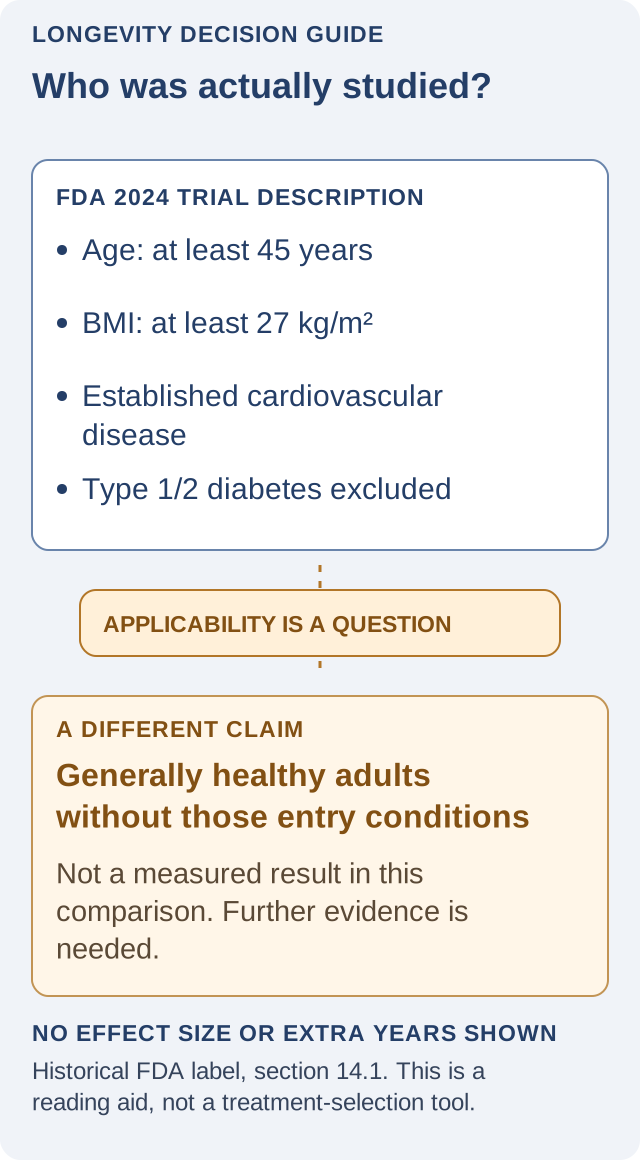
Figure: a population boundary, not a treatment-selection tool. The first panel summarises the historical FDA section 14.1 entry criteria. The second identifies an extrapolation question; it is not another study group and contains no measured result. The gap is not evidence that benefit is impossible. No effect sizes, added years or biological-age changes are plotted.
Keep the outcome and the setting attached
The FDA's 8 March 2024 announcement describes cardiovascular-risk evidence in adults with cardiovascular disease and overweight or obesity. It also notes that both trial groups received usual medical care and lifestyle counseling. A summary that omits the underlying risk and accompanying care changes the question the result appears to answer.
When evaluating a new headline, write four short notes:
- Population: which conditions, ages and other criteria defined entry? What did an exclusion actually exclude?
- Comparison: what did the comparison group receive, including other care?
- Outcome: what event or function was measured? Is a broader longevity claim being added in the retelling?
- Applicability gap: which important features differ between the studied people and the people named in the claim?
These notes do not produce a personal benefit estimate. They identify where another study or a clinician's judgment would be needed. Similarity in one feature cannot establish that the overall benefits and harms will be the same.
A different question from whether an aging clock is valid
Population applicability and biomarker validity are separate checks. A study can measure a clinical outcome in one population while leaving another population untested. For the separate step from a younger test score to a health-benefit claim, read the biological-age evidence map.
Sources checked on 23 October 2026. The conclusion is limited to the inference being made: this trial description alone cannot establish a general healthy-adult longevity benefit. That limit is not proof that every possible benefit in another population is absent.
Sources
- Wegovy prescribing information, March 2024 version — section 14.1
- FDA Approves First Treatment to Reduce Risk of Serious Heart Problems Specifically in Adults with Obesity or Overweight
Applying the evidence
A verdict about a claim is not an individual screening plan. Read the screening guide and discuss your history, prior results and possible follow-up with a qualified clinician.