An experimental drug is in a human trial. Does that show it works?
Read a trial announcement as a research question. Separate the study being available, the results actually reported and the particular benefit being claimed.
A human trial establishes that a question is being investigated. Its existence alone does not answer that question. For a longevity claim, ask what result has actually been reported and whether it supports the particular benefit being advertised.
The FDA's clinical research explanation describes trials designed around specific questions and a protocol. That plan addresses participants, duration, comparisons, assessments and analysis. Different phases have different purposes: early research focuses on matters such as safety and dosage; later studies investigate treatment benefit and adverse reactions. A phase label therefore needs context, not a translation into “works.” These are U.S. drug-development explanations, not a global approval rule for every intervention marketed for longevity.
Read three different statements
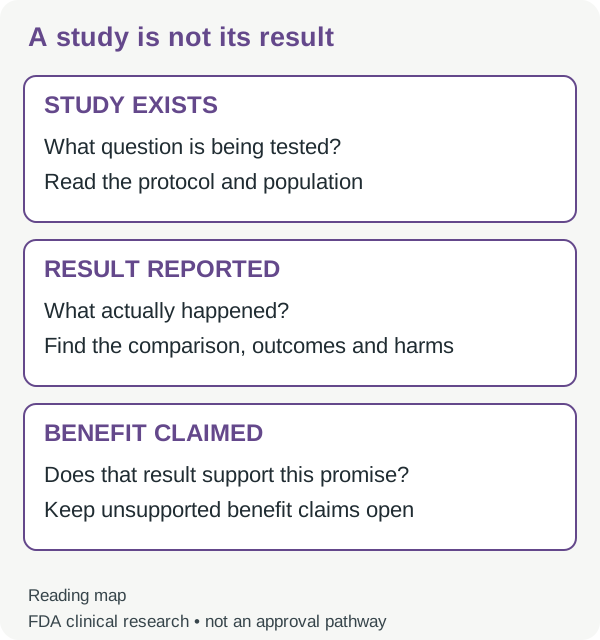
Figure: three claims to check separately. Original reading map informed by the FDA's description of trial design. It is not a regulatory flowchart, an evidence score or a prediction that an experimental drug will succeed. An empty results field should stay empty.
Find the result before evaluating the promise
A recruitment announcement can help locate the study. It is not a substitute for the result. In your notes, separate the link describing the research plan from the link reporting what happened. If you have only the announcement, write “results not reviewed” rather than an effect estimate.
When a result is available, write down the population, comparison, measured outcome and follow-up period. Then copy the promotional benefit into a separate sentence. Are both sentences about the same thing? A claim about longer human life requires evidence relevant to that outcome; the phrase “human trial” does not supply it.
This is a reading exercise, not a full appraisal of a study. Missing information may require the complete report and expert interpretation. A press release, abstract or promotional summary should be labelled as the material actually read.
Keep uncertainty and harms in the same note
Use three short entries:
- Research question: What did this study set out to test, and in whom?
- Reported finding: What changed compared with what, over which period, and with what uncertainty?
- Open questions: Which harms, missing results or limits matter to the benefit being claimed?
Do not fill an unanswered entry with an animal result, a proposed mechanism or the fact that places are available in a trial. The population boundary guide helps check who was studied. The biological-age comparison addresses the separate question of what a clock result measures.
Participation is a separate decision
Reading a study does not determine whether you should join it or obtain the experimental product. If participation is being considered, discuss the actual protocol, eligibility, alternatives and risks with the research team and your clinician. This page does not recommend an experimental drug, provide a dose or establish a route to access it.
Source checked on 6 November 2026; no revision date was visible in the material read. No specific investigational product, current trial result, regulatory authorization or extension of human lifespan has been verified in this article. ClinicalTrials.gov pages that did not return readable substantive text were not used as evidence.
Sources
Applying the evidence
A verdict about a claim is not an individual screening plan. Read the screening guide and discuss your history, prior results and possible follow-up with a qualified clinician.